· Updated · News
All chapters in: Digital Twins in Medicine book enters Open Access production
Robin Wilkening, Open Science Institute
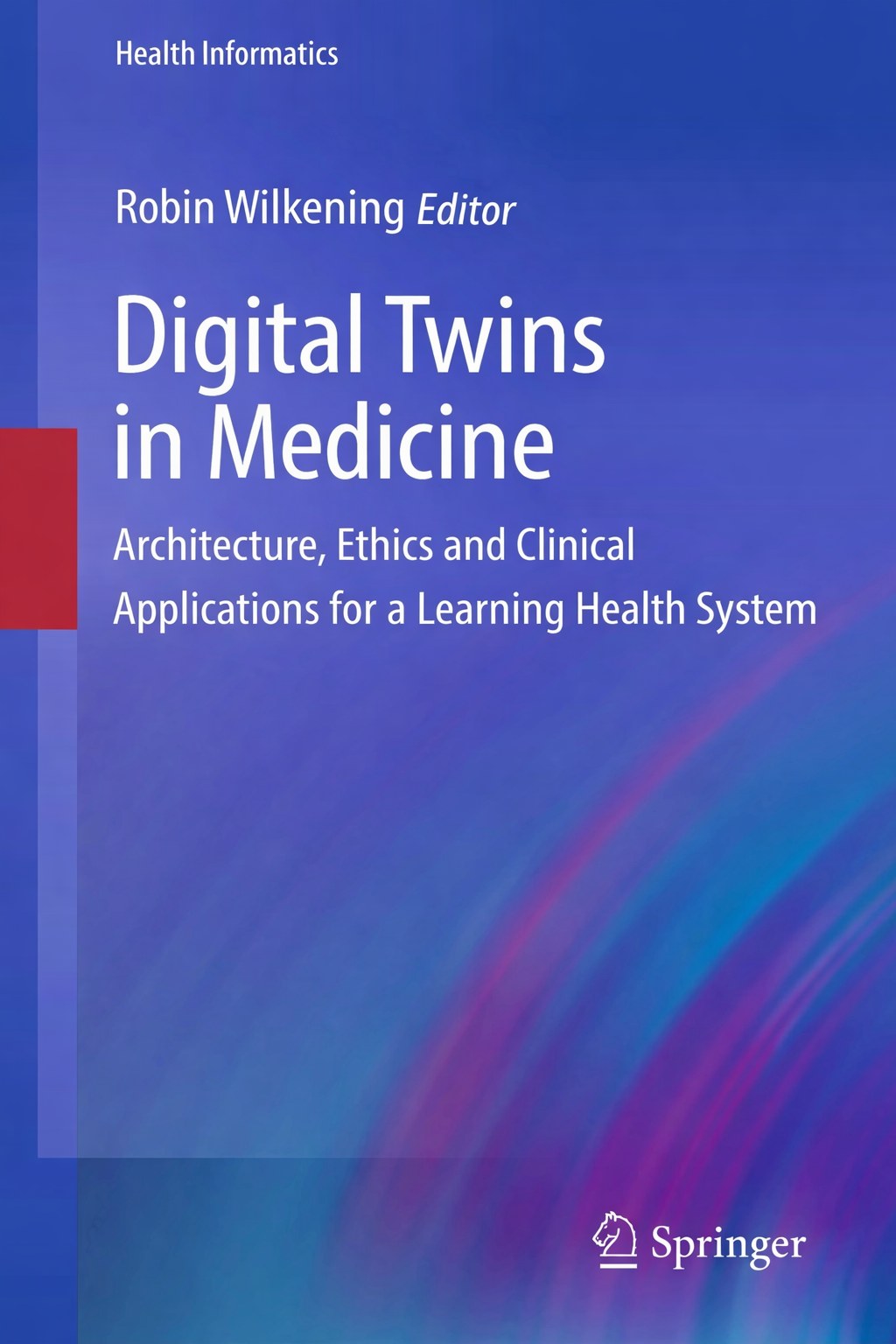
All thirteen chapters are in. Each has been submitted, peer reviewed and revised, and the volume now moves into Open Access production for Q4/2026. Thirty-seven authors contributed. Submissions came in against an April 1st deadline, ran through peer review and revision, and the last acceptances landed in early July.
The book
The volume appears in Springer's Health Informatics series, edited by Robin Wilkening, at roughly 240 pages. Thanks to support from the Open Science Foundation, it will be published Open Access.
The argument the book makes is that digital twins in medicine are no longer a metaphor. By integrating multimodal health data into computational models, they support personalised prediction, simulation and continuous learning, and they sit at the join between digital health, systems medicine and artificial intelligence. What has been missing is not enthusiasm but an interdisciplinary frame, one that holds architecture, computation, ethics and clinical practice in the same view rather than treating them as separate literatures.
Thirteen chapters, three sections
Foundations and Architecture of Digital Twins in Medicine establishes the technical base: digital twins as core infrastructure for a learning health system, the multi-layer architecture of the human digital twin, and verification, validation and uncertainty quantification for trustworthy medical twins.
Ethics, Governance, and Societal Implications takes the harder questions early rather than appending them as a closing caveat: ethical foundations; governance models for responsible twin ecosystems; security, privacy and governance in healthcare deployments; and our own contribution, Building an Open Twin Ecosystem: Reference Infrastructure, Governance, and Adoption Pathways, which carries the foundation's position that twin infrastructure has to be open to be trustworthy.
Clinical Applications and Future Directions is the largest section, six chapters covering health promotion and preventive medicine, cardiology and chronic disease management, oncology and personalised treatment pathways, digital twin-assisted surgery, dermatology, and psychiatry and mental health.
The author field
Thirty-seven authors contributed, and the list reads as a working map of who is actually building medical digital twins right now. A few of the names give the measure of it.
Liesbet Geris is Executive Director of the Virtual Physiological Human Institute and coordinator of the EDITH Coordination and Support Action, the €5m European effort that produced the roadmap for the Virtual Human Twin, so the governance chapter is written from inside the process that is currently defining European policy on this.
Pablo Lamata at King's College London directs the Centre for Doctoral Training in Digital Twins for Healthcare and led the construction of more than 3,800 anatomically accurate cardiac twins, published in Nature Cardiovascular Research.
Caroline Chung is Chief Data and Analytics Officer at MD Anderson Cancer Center and served on the US National Academies committee on foundational research gaps for digital twins.
Roozbeh Jafari, formerly of Texas A&M and MIT Lincoln Laboratory and now a program manager in DARPA's Biological Technologies Office, built much of the wearable sensing that makes continuous, real-world twin input possible.
H. Peter Soyer at the University of Queensland leads ACEMID, the Australian 3D total-body imaging network for melanoma detection.
Gökhan Ertaylan at VITO works across systems medicine, data science and regulatory science, led the "I am Frontier" deep-phenotyping cohort, and is a partner in EDITH; he writes the architecture chapter.
Around them: modellers, clinicians, ethicists, security researchers and infrastructure people, from Europe, North America and Australia. That mix was the editorial goal from the start, and it is the reason the book took the shape it did.
What comes next
Production runs through the autumn: copy-editing, figures, proofs and the Open Access licensing steps, with publication targeted for Q4/2026. Authors will receive proofs during that window.
Our own chapter connects directly to work happening on the ground. The argument that open reference infrastructure is a precondition for trustworthy twins is being tested in the OpenTwin project, where the BodyLoop body scanner recently arrived and gave the project its first physical measurement layer.
We will post the DOI and the open link here as soon as the volume is live.
Licensed under CC BY 4.0. Free to share and adapt with attribution. (link opens in a new tab)