· News
How we build an open human body for our digital twin, in the browser
Martin Etzrodt, PhD, Open Science Institute · Prof. Robin Wilkening, Open Health
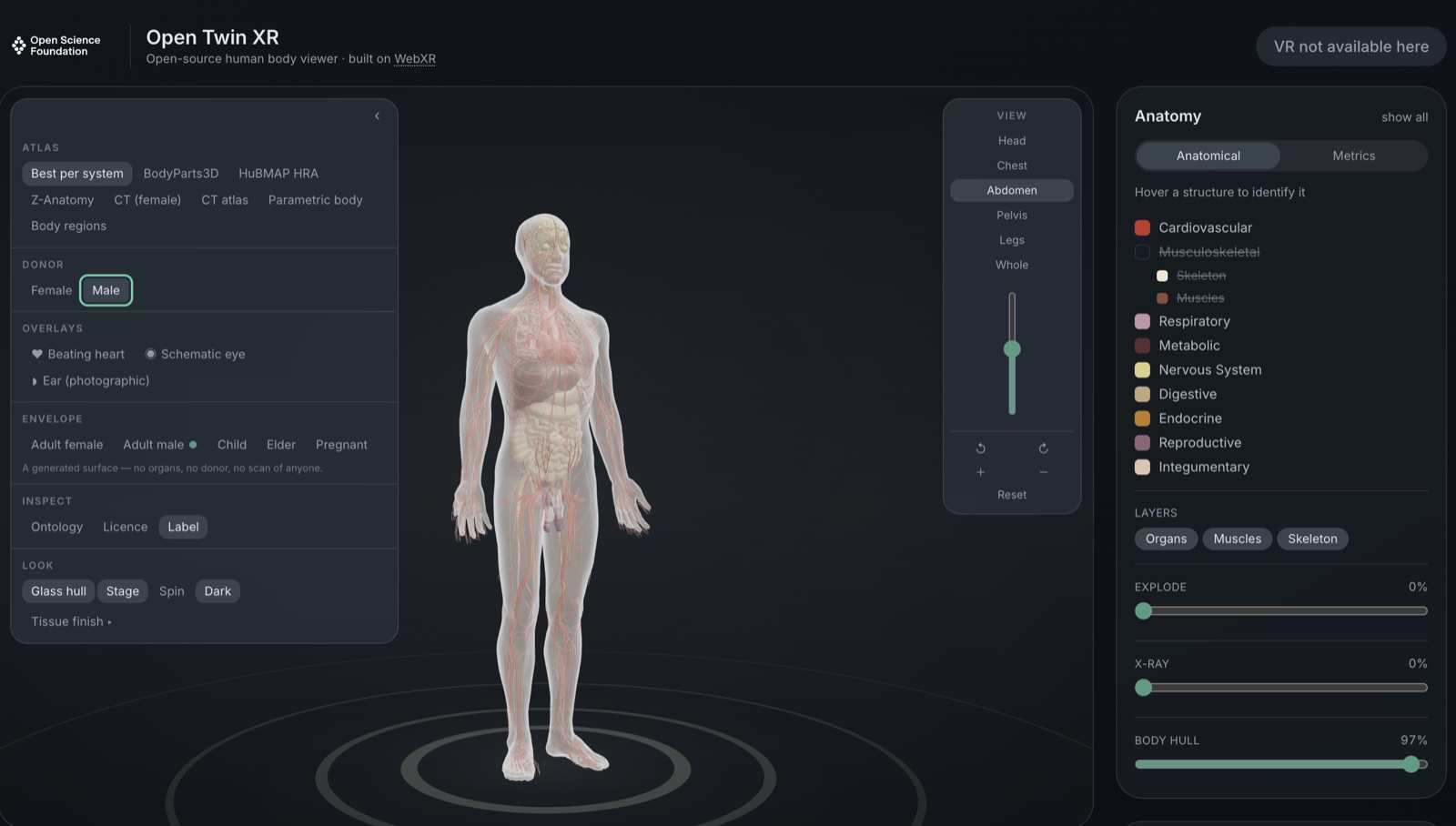
When building a human digital twin, starting with an accurate anatomical representation of the human body seems the first logical step. But what is already out there? Are there any open models we can rely on? This is exactly what we embarked on in building OpenTwin XR, an open-source 3D viewer of existing models of the human body. The immersive viewer is built using WebXR and can also run directly in the browser without the need of installation. While the viewer itself is MIT licensed, the anatomical models retain the licences and attribution requirements of their original sources.
We have identified a number of well documented anatomical datasets that could be integrated and are now available for comparison. These include BodyParts3D from Japan's Database Center for Life Science, the Z-Anatomy atlas built by a community around Gauthier Kervyn, and the male and female reference anatomies from the HuBMAP Human Reference Atlas, an open-source platform to discover standardized organ, cell type, gene, and tissue data across the human body. We also identified two datasets of bodies reconstructed from real CT scans. In all, several thousand individually selectable structures are now available, with the most detailed atlas containing 3,617 of them.
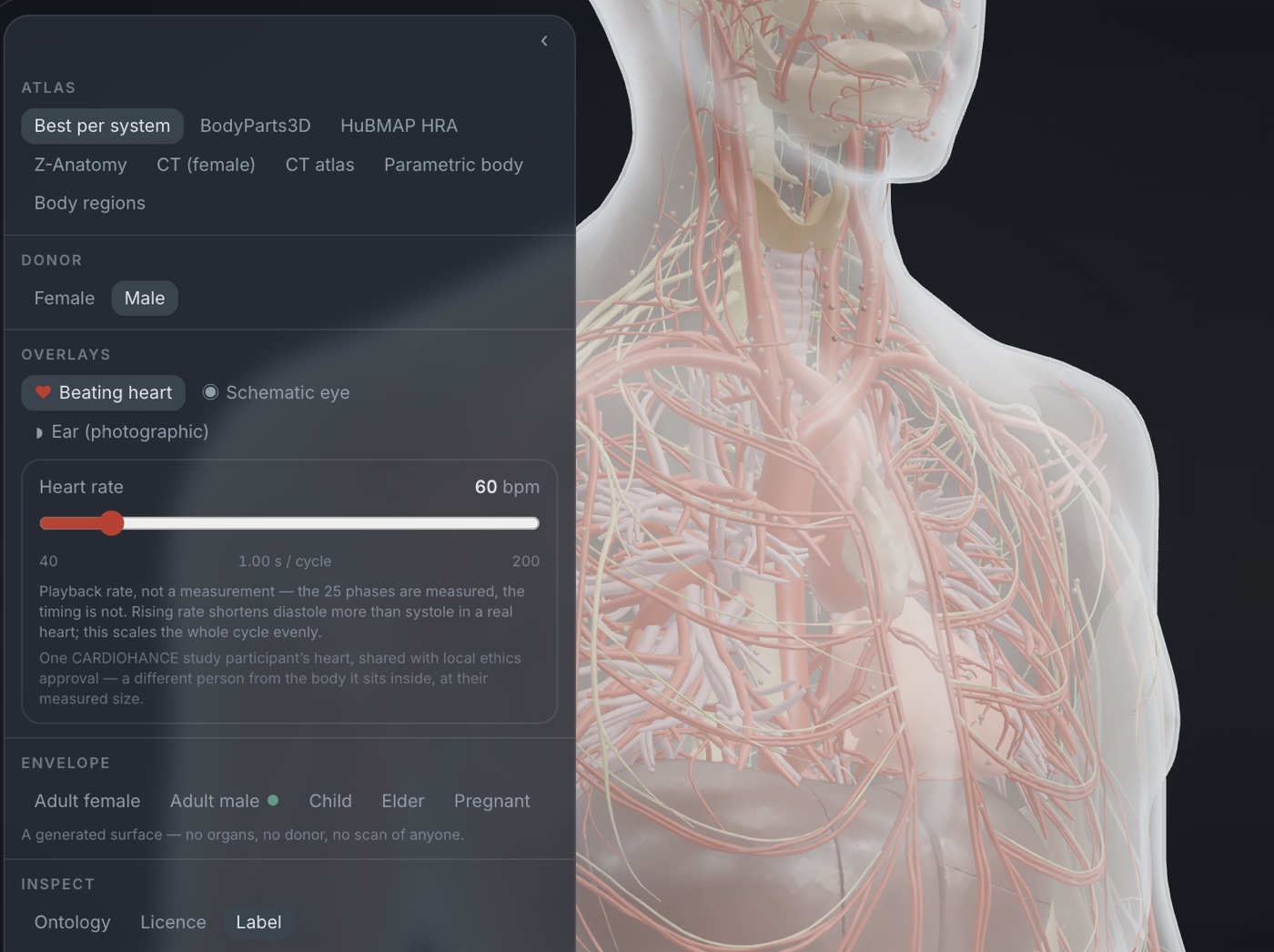
Our viewer allows switching between the integrated anatomical datasets. We also include specialised models the atlases do not provide, but that can be added within them: researchers created an animation of a biventricular heart across 25 cardiac phases, fitted to cine MRI data, which can be embedded into any of the models and replayed at different heart rates. We also found the data of a human temporal bone whose surface colours were derived from photographs of the same specimen. The tissue therefore looks as it actually appeared, not as imagined or painted.
For our application two things were especially important.
1. Structures know what they are
A liver in our viewer is not simply a mesh named "liver". Instead it is matched with an ontology identifier. In the Uberon Multi-Species Anatomy ontology, liver maps to the identifier UBERON:0002107. It also maps to FMA, another domain ontology that represents a coherent body of explicit declarative knowledge about human anatomy. Using ontologies we can assign any body structure a machine-readable biological identity.
All 1,838 BodyParts3D structures now have an FMA identifier, and approximately half of the Z-Anatomy structures have already been mapped. For 457 structures, the viewer can also provide the ontology's own definition of the selected anatomy.
This semantic layer is what will eventually allow the body viewer to connect reliably with real data. A name can change between models and languages; a stable identifier can survive an atlas swap.
2. Provide documented provenance
Anatomical models often originate from donated bodies, medical imaging, physical specimens or research participants. Their origins and conditions of use therefore matter. As an organisation that aims to promote openness, we rely on the very fact that others have provided us with open and accessible data. We want to ensure that we attribute each work accordingly.
Each model in the viewer is listed with its licence to ensure documenting where the model came from, who created it, and under which terms it may be used. While the viewer code we generated is open source MIT licensed, individual anatomical datasets remain governed by their respective licences.
We ultimately aim to overlay the anatomical features with spatial, possibly real-time medical data from wearables, as part of the wider OpenTwin project. The anatomy viewer currently helps us map what open resources there are. It does not claim to provide any medical insight or advice.
Code is available on GitHub. The viewer runs without local installation on the browser. Issues and pull requests are welcome!
Licensed under CC BY 4.0. Free to share and adapt with attribution. (link opens in a new tab)